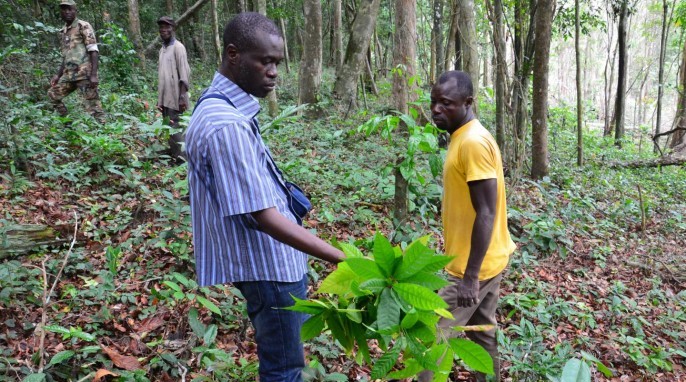








Photosynthesis is how plants convert light into food, and this team of scientists test how gene changes can multiply the process.
Algae are better at photosynthesis than land plants because they are able to concentrate the enzyme called Rubisco, which fixes carbon dioxide, into organelles called pyrenoids. This makes more carbon dioxide available to use to make sugars in photosynthesis. If food crops like soybeans and rice could do this, it would increase crop yields. But algae are evolutionarily very different from food crops, and engineering a gene from algae into land plants has not been successful.
A team of scientists spanning Cornell University, Boyce Thompson Institute, and the University of Edinburgh found a gene similar to the one in algae. This gene does the same thing in hornworts, which are primitive land plants that are evolutionarily closer to crop plants. They incorporated this gene from hornworts into some land plants, including a common lab plant, Arabidopsis, and it works the same way as it does in hornworts. If this gene could be incorporated into the genome of rice, wheat, or barley, it could dramatically increase the yield, resulting in more food for the world.
Photosynthesis steps
Photosynthesis is the process by which green plants use light energy to make food from carbon dioxide and water. Oxygen is a waste product of photosynthesis and is released when the plant splits water and uses the hydrogen.
Photosynthesis starts when light energy is absorbed by protein pigments, usually chlorophyll. Chlorophyll is typically enclosed in a membrane-bound organelle, a chloroplast. Inside the chloroplast there are many, many Rubisco molecules. These enzymes fix carbon dioxide and eventually produce glucose. Thus light is converted to chemical energy, which is food.
RELATED: Lasers Shed Light on Photosynthesis
What is Rubisco?
Rubisco is ribulose-1, 5-bisphosphate carboxylase. It is the enzyme that catalyzes the fixation of atmospheric carbon dioxide and the production of glucose in the light independent reactions of photosynthesis. It is the most common enzyme on Earth, because every plant that does photosynthesis needs a lot of it.
As stated above, the waste product of photosynthesis is oxygen. Rubisco evolved on Earth before there was oxygen, and it is the reason there is oxygen in the atmosphere now.
Rubisco captures carbon dioxide, which is called carboxylation. It attaches the carbon dioxide to itself. The resulting molecule goes through a cascade of chemical changes and ends up being glucose, or simple sugar. When a bunch of glucose molecules are joined together, that is a carbohydrate. This is food for us, like rice, wheat, or even oranges and green beans.
Rubisco is inefficient, especially in high oxygen environments. In most plants, Rubisco is distributed throughout the chloroplast, but in algae and in hornworts, it is condensed into pyrenoids. This makes carboxylation more efficient.
What are pyrenoids?
Pyrenoids are inside chloroplasts, where photosynthesis occurs, but they only occur in algae and hornworts. Pyrenoids collect carbon dioxide and keep it around the Rubisco enzymes. This way, when the Rubisco finishes with one carbon dioxide, there is another one right there, ready for the next reaction. Rubisco is always surrounded by carbon dioxide, and this increases the speed and efficiency of carboxylation.
Pyrenoids probably evolved in algae because algae lives in water, and water has a low or unavailable amount of carbon dioxide.
RELATED: Sink and Swim at the Lake: Littoral Zones Are Now Carbon Sinks
What are hornworts?

Hornworts are bryophytes and the only land plants that have a pyrenoid-concentrating mechanism. They are primitive, nonvascular land plants, similar to mosses and liverworts. Because they are nonvascular, they grow in places that are wet.
RELATED: Genome Revelations: How Green Plants Evolved
The study
The research team studied the hornwort Anthoceros agrestis. They found a mechanism that concentrates Rubisco, but it is different from the mechanism used by algae. The researchers found the gene for this mechanism. They reasoned that if they put this gene from A. agrestis into a closely related hornwort, A. fusiformis, which does not produce pyrenoids, A. fusiformis would produce pyrenoids. They were correct.
Then, they tried the same procedure with the common lab plant Arabidopsis, and again, pyrenoids formed.
Implications for future study
The researchers concluded that transplanting this gene into food plants will result in increased carbon dioxide fixation and therefore increased crop yields. The process of inserting genes into unrelated organisms is complex. Thus far, they have not inserted the gene into crop plants, but since the gene worked in Arabidopsis, it is reasonable to conclude that it will probably work in other angiosperms.
Rubisco is inefficient in an environment with high oxygen. The pyrenoids overcome some of that problem, but they work best in an environment of low carbon dioxide, in wet, or water environments. It is difficult to ascertain how they will work in a high oxygen and high carbon dioxide environment.
Inserting a gene from a nonvascular plant into a vascular plant with similar effects is a significant achievement and could result in an increased food supply.
This study was published in the peer-reviewed journal Science.
Reference
Robison, T. A., Mao, Y., … & Li, F.-W. (2025). An unconventional Rubisco small subunit underpins the CO2-concentrating organelle in land plants. Science, 391(6789), 1070–1075. https://doi.org/10.1126/science.aea0150

About the Author
Helen Petre is a retired biologist and college biology instructor. She writes nature articles, volunteers for science activities, and is always learning about science.