Science Snapshot: Formation of a Second-Generation Planet
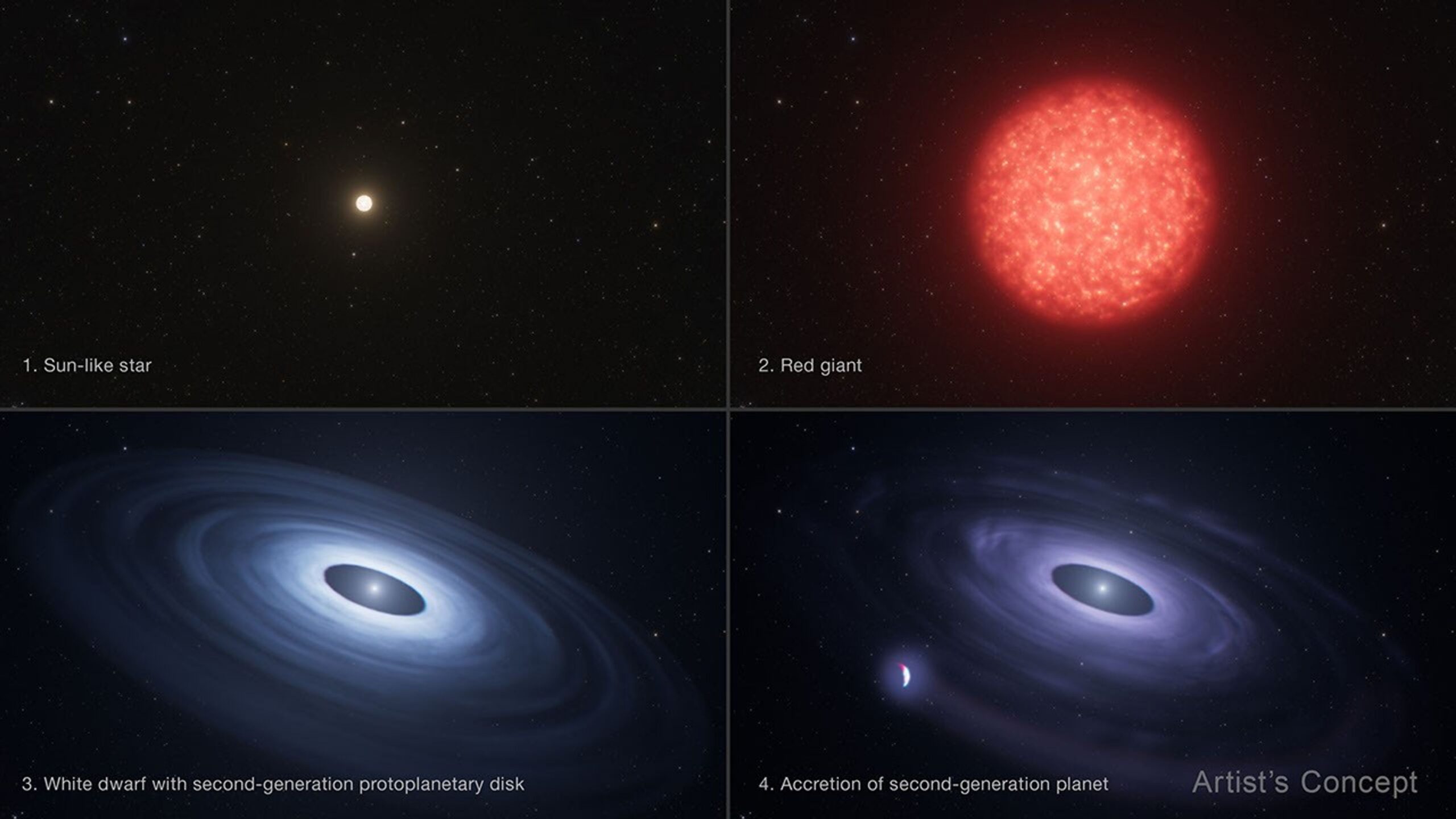
NASA Hubble telescope data re-examined: the evolution of a Sun-like star as it dies and potentially forms into a second-generation planet.
“Rather than the white dwarf stage being a kind of epilogue to the story of a star and its planets, this research points to the systems we are familiar with only being the first chapter of a potentially much longer tale, with some new characters showing up. That’s a really exciting prospect to pursue,” said Jamie Williams, PhD candidate at the University of Warwick and lead researcher on the study.
Williams worked with a team of astronomers to study white dwarf star HS 0209+0832, using NASA’s Hubble telescope and TESS satellite data going back to 1999. They identified a high abundance of niobium as the star dies and releases chemical materials, which could indicate that a second-generation planet will form.
Read more about their findings published in the peer-reviewed journal Nature Astronomy.
Featured image:This artist’s concept, not to scale, imagines the evolution of a Sun-like star (1), into an aging red giant (2), and then a small, bright white dwarf surrounded by a disk of its expelled outer layers (3), from which a second-generation planet forms (4). Credit: NASA, ESA, Leah Hustak (STScI)
Learn more about Hubble data
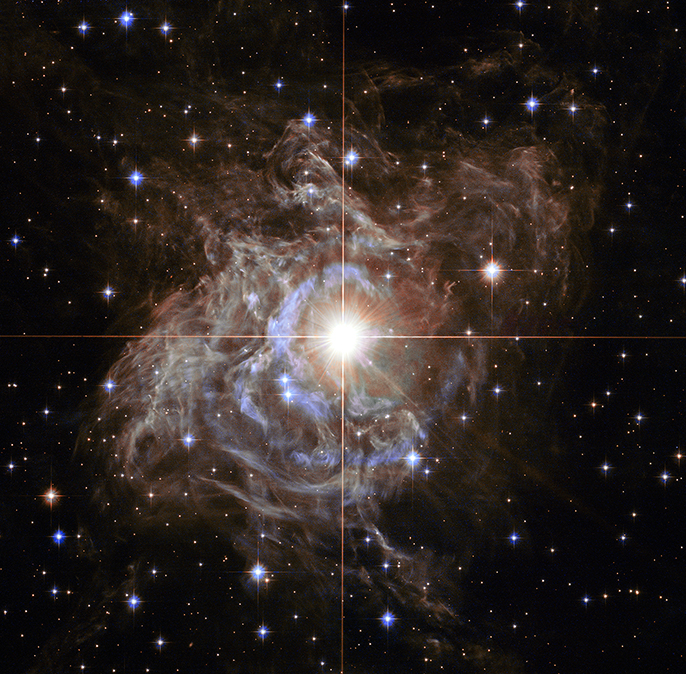
RS Puppis as imaged by Hubble (HST) “This Hubble image shows RS Puppis, a type of variable star known as a Cepheid variable. As variable stars go, Cepheids have comparatively long periods— RS Puppis, for example, varies in brightness by almost a factor of five every 40 or so days. from http://www.spacetelescope.org/images/heic1323a/ [ESA/Hubble Public Domain]
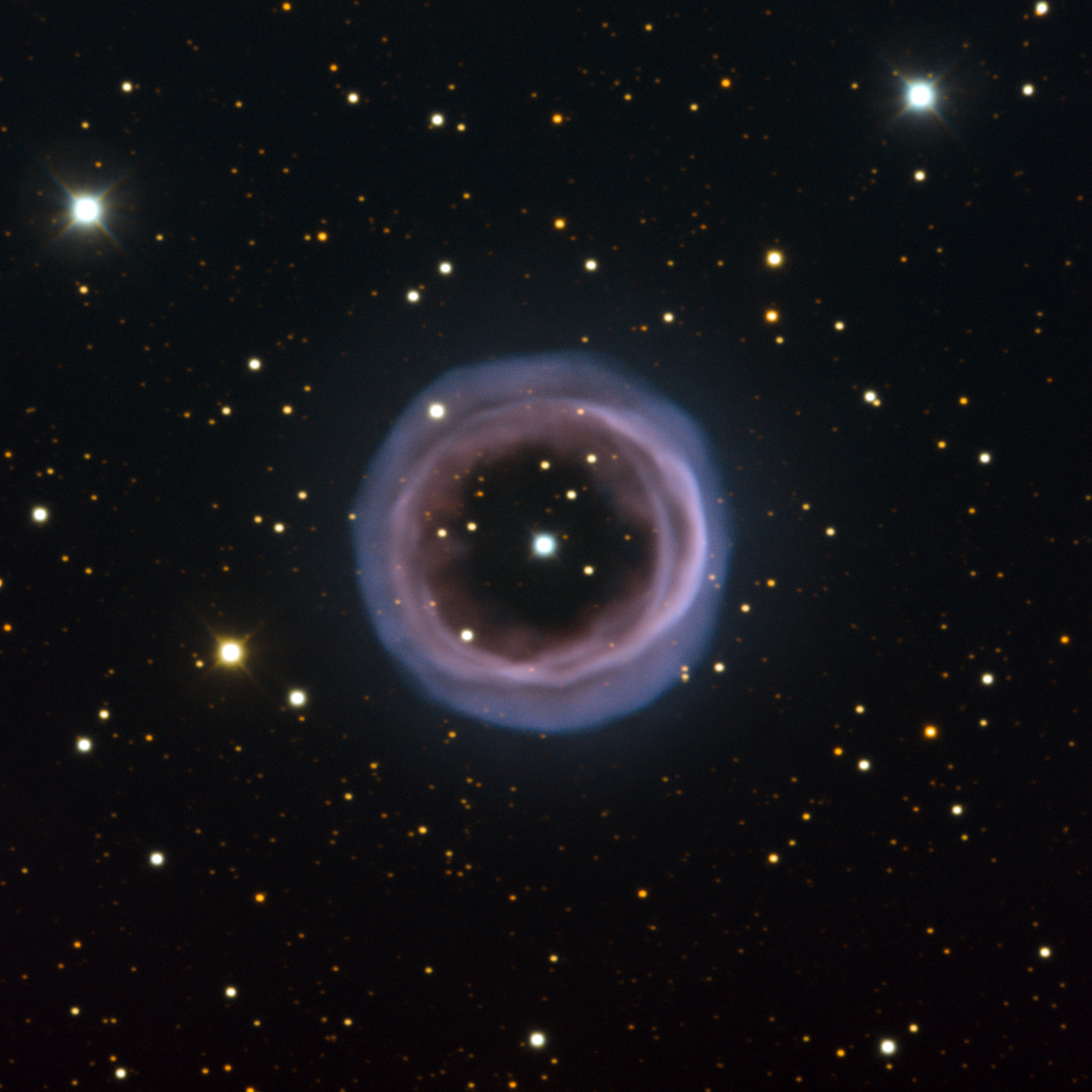
The hazy and aptly named Fine Ring Nebula, shown here, is an unusual planetary nebula. Planetary nebulae form when some dying stars, having expanded into a red giant phase, expel a shell of gas as they evolve into white dwarfs. Most planetary nebulae are either spherical or elliptical in shape, or bipolar (featuring two symmetric lobes of material). But the Fine Ring Nebula — captured here by the ESO Faint Object Spectrograph and Camera mounted on the New Technology Telescope at the La Silla Observatory in Chile — looks like an almost perfect circular ring. Astronomers believe that some of these more unusually shaped planetary nebulae are formed when the progenitor star is actually a binary system. The interaction between the primary star and its orbiting companion shapes the ejected material. The stellar object at the centre of the Fine Ring Nebula is indeed thought to be a binary system, orbiting with a period of 2.9 days. Observations suggest that the binary pair is almost perfectly face-on from our vantage point, implying that the planetary nebula’s structure is aligned in the same way. We are looking down on a torus (doughnut shape) of ejected material, leading to the strikingly circular ring shape in the image. Planetary nebulae are shaped by the complex interplay of many physical processes. Not only can these celestial objects be admired for their beauty, but the study of precisely how they form their striking shapes is a fascinating topic in astronomical research. This image was made using multiple filters: light observed through B and O-III filters is shown in blue, V is shown in green, R is shown in orange, and H-alpha in red. The image is approximately 200 arcseconds across.
More than a century ago, women called “human computers” changed our understanding of the universe. Now volunteers are making discoveries in their old notebooks.