






A study of personal care and cleaning products found that most contain undisclosed chemicals, or chemicals that are not listed on the label.
By Helen Petre
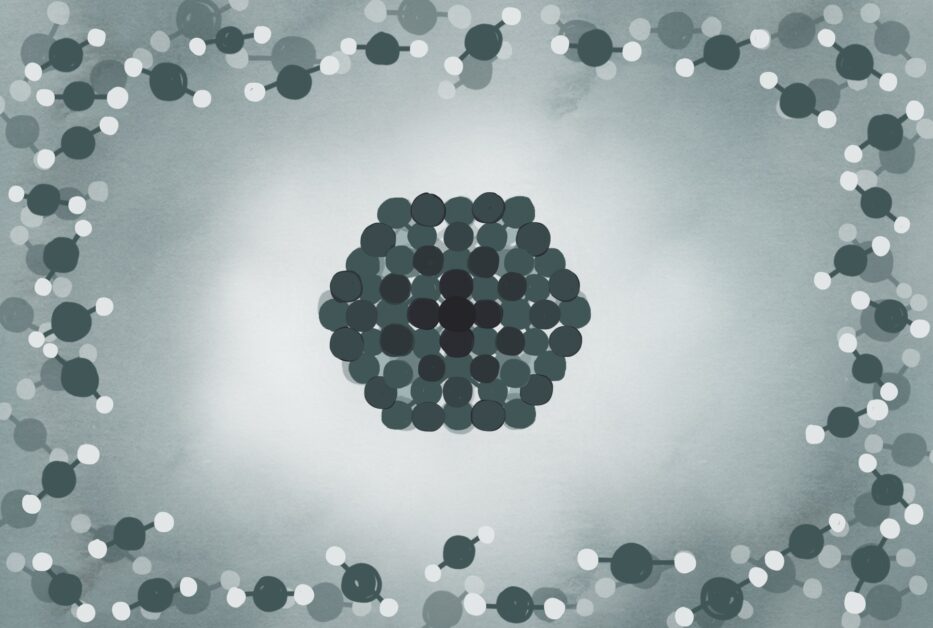
A new study of personal care and cleaning products found that most contain undisclosed chemicals, or chemicals that are not listed on the label. Most of the products tested contained chemicals with known or suspected health hazards, and 25 percent contained chemicals that directly contradicted the label. For example, products with labels that said “No phthalates” actually contained phthalates.
Most of us actually do not read the labels, especially of things like shampoo, hairstyling products, or sunscreen, but maybe we should question what we are putting on our bodies. The average number of ingredients listed on the label of the tested products is 16, but this study found an average of 51 components actually in the products. That is three times as many. That is significant. What is more, 85 percent contained chemicals known or suspected to be harmful.
The undisclosed ingredients were endocrine-disrupting chemicals, such as bisphenols, phthalates, and parabens, fragrances, and butylated hydroxytoluene (BHT). Some of these chemicals have been linked to infertility, miscarriage, diabetes, cancer, and allergies.
RELATED: The Role of Microplastics in Neurodegenerative Diseases
How did this stuff get there?
Based on the results, and the fact that the US does not regulate non food or drug products, it is reasonable to think that the manufacturers put the chemicals in the products, but that is not always the case. Sometimes the packaging process, or the packaging itself, contains harmful chemicals not intended to be in the product. Even cleaning products used in the manufacturing plant can end up in the package. Endocrine disruptors are commonly used in plastics, so it could be the container that is contributing the ingredients, and not the ingredients.
RELATED: We Have Plastic in Our Brains: A New Study
The study
Scientists at the Million Market Research Institute, a private, independent testing lab, set out to test individuals’ levels of endocrine-disrupting chemicals (EDCs). The researchers developed a urine-based test for EDCs and had volunteers test their urine. They provided the results and information on how to reduce exposure. Then, they retested. Surprise. The volunteers, who said they had used the suggested reduction methods, had high levels of parabens, oxybenzone, and phthalates.
The scientists knew that ingredient-based suggestions were not capturing all the risk. As their next step, they tested 113 products to see if the ingredient lists matched the ingredients. They chose products based on what the volunteers reported using. Most were shampoo, hairstyling products, sunscreen, hand lotion, diaper rash cream, soap, deodorant, lip balm, mouthwash, toothpaste, and laundry products. That is a rather extensive list, and includes products we all use. They purchased the products from major retailers, Walmart, Amazon, Target, just like we do.
The results
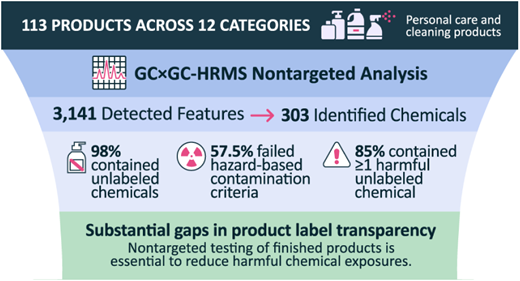
Of the 113 products, 106 products, or 98 percent, contained ingredients not on the label. Detected chemicals were fragrances, plasticizers, antioxidants, and siloxanes. Several of the components were present at high levels, findings that indicate mislabeling is not a rare occurrence. To be fair, the researchers exempted some botanical chemicals from the results because plant-based products contain chemicals in plants, for example, citronellol, limonene, and myrcene.
The products that contained the most undisclosed chemicals were housecleaning products, hairstyling products, hand lotions, shampoo, and sunscreen. Thankfully, mouthwash and toothpaste did much better. The probable reason is that in the US, fluoride-containing products are regulated as drugs.
The researchers did suggest that certain ingredients, such as benzyl chloride, dodecyl chloride, and 2-ethylhexyl glycidyl, which were found often in multiple products, could be from the packaging. Companies do not legally have to disclose the ingredients for many products, which is why there are so many undisclosed chemicals. Some ingredients are trade secrets, but some are also harmful. While plant products are natural, they are not always safe.
The US relies on voluntary disclosure, which means there is no oversight.
Research takeaways
The importance of this research is to stress the importance of testing products as finished products, not as samples during the manufacturing process. The scientists also note that the US relies on manufacturers to report the contents of their products and there is no oversight. Companies know that. Routine testing of finished products is not required, nor is it done.
The article was published in Environment and Health, a peer-reviewed journal of the American Chemical Society.
Reference
Schultz, K., Rochester, J. R., Latrop, M. K., … & Hua, J. (2026). Hidden hazards: Nontargeted chemical analysis reveals widespread contaminants and mislabeling in personal care and cleaning products. Environment & Health. https://doi.org/10.1021/envhealth.6c00181. Visual abstract shared above is licensed under CC BY-NC-ND 4.0.

About the Author
Helen Petre is a retired biologist and science writer.