








Bat communication through echolocation involves sound, and it has more similarities to human communication than you may have guessed.
By Sandra Lu
For most of us, the few facts we may know about bats are that they fly at night and they make high-pitched sounds while flying out of caves. But how do they fly at night, and why do they make those high-pitched sounds?
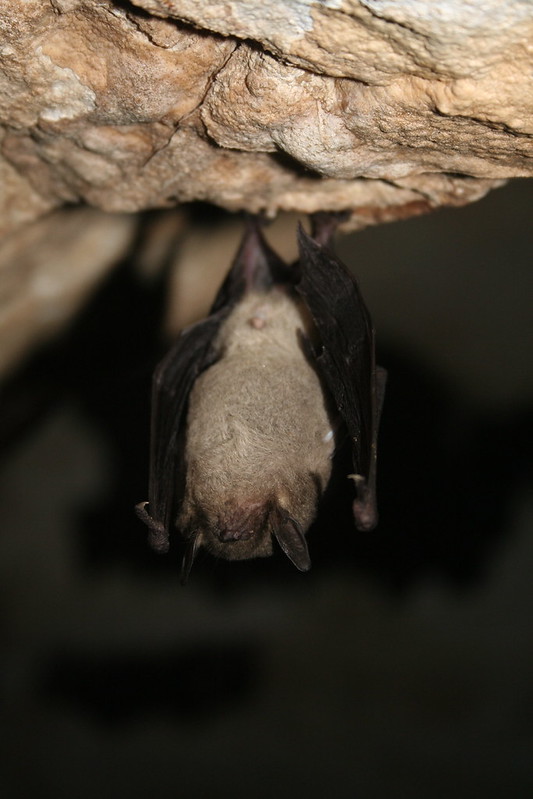
Virginia Tech researchers based in Blacksburg, Virginia, specifically dove into this process with wild gray bats, or Myotis grisescens. They observed how their sounds changed when they fly alone or in groups and how they encounter obstacles. Understanding more about these gray bats will educate us on the diverse ways animals use sound and will spread curiosity as we compare them to other species like ourselves.
Parallels between bat and human communication
At first glance, human speech and bat echolocation sound nothing like each other. However, both are ways of exchanging information, which is defined as communication. Humans use their voice to share important knowledge and to process new information. Likewise, bats use sound to share incoming data to other bats and themselves for visualizing their surroundings.
To make this comparison more digestable, let’s think of speech and words as more of a sound wave. Similar to tuning radio waves from radio stations, and the slow beeping of sonar waves from a submarine. All of these waves enter the ears of the listener to be deciphered and analyzed by the listener’s brain to create meaning behind the string of sounds. That is why the sound waves created by humans are able to be understood by other humans as language.
It’s amazing that certain sounds humans create, allowed by our fluctuating voice box and the shape of our lips, have opened up the floor for meaningful understanding. Bats, in a similar sense, have evolved to capitalize on the tool of sound. Their outward sound waves and their highly capable ear drums allow for them to hear sound waves that us humans are unable to capture.
RELATED: Using your voice to communicate leads to stronger social connections.
What is echolocation?
Echolocation, if the word is unfamiliar to you, describes the “reflecting” nature of sound to determine surrounding objects, whether they are enormous mountains or small prey. Have you ever been under a huge dome and every step you take echoes all around you? Or been under a long, concrete tunnel and all words you call out to friends are repeated over and over by the walls?
These kinds of echoes are what bats use to determine how far away an object is and its size. Their ears and brains are specifically designed to be able to capture this echo accurately and determine the object’s size and its distance from them.
Let’s dig deeper into bats and their use of echolocation as another way to visualize their surroundings.
How bats deal with loud situations
Researchers observed echolocation patterns in a group of bats compared to that of the individual bats. We might assume that the more bats there are, the more calls would be made. However, they found that bats make fewer calls within a larger group of bats than in a smaller group. Why is that?
Think of a crowded room with many people talking over each other and inevitably yelling from one end of the room to another. You can imagine how chaotic and indecipherable the noise can become the more people in the room who are speaking. This same lively room started off with people talking at a normal volume, but the more people there were, the more they started raising their voice to be heard by others.
In order to reduce this kind of interference in their conversations, these bats tend to be more selective with the calls they make to decrease the noise in the air. They also change their acoustic power, or their speech level, to increase the probability that they will be able to hear their echolocation uninterrupted. The bats can adjust their speech levels to either lower or higher volumes in order for their sound waves to stand out from that of their neighbors. This is scientifically called the jamming avoidance response.
How bats overcome barriers in communication
Obstacles also present a challenge for bats in flight. Just like they are for humans. You have to keep them in mind when walking down the street and moving through your own house to make sure you make it through safely. Bats have to keep in mind trees, power lines, buildings, and other objects that may be in their way as they’re hunting.
Read more about what bats eat and how it helps the ecosystem.
These obstacles present another difficulty with communication. A giant rock wall separating you and your friend would make it a lot more tiresome for both of you to have a conversation. This would cause you to shorten your sentences and raise your voice in order for them to hear you. Although not exactly the same, obstacles do cause changes within bat conversations. When bats use echolocation, their voices are reflecting off objects that are close by and coming back to their ears. If a giant rock wall is close by and their high-pitched voice reflects back at almost full intensity, this can damage their sensitive ears. They adjust by lowering their voice level and making fewer calls as they navigate through the area. Even more so if there is a large group of gray bats traveling together because, as described above, their calls are already limited to avoid interference.
In general, speech level and the amount of gray bat calls decreases as gray bat group sizes increase. This is especially true when there are obstacles in the way. This can all be seen similarly in humans and how we instinctually adjust our interactions with each other and our surroundings. By realizing these pockets of similarities that we share with the living creatures around us, we can continue to foster education and connection with them.
This study was published in the peer-reviewed journal PLOS Complex Systems.
RELATED: Learn more about the fungus that causes white-nose syndrome, a deadly bat disease in North America.
Reference
Grey, M., Aung, E., & Abaid, N. (2026). Group size and environmental obstacles drive acoustic call properties for gray bats in flight: A data-driven analysis. PLOS Complex Systems, 3(4), e0000100. https://doi.org/10.1371/journal.pcsy.0000100
Featured image by Peter von Bagh on Flickr, licensed under CC BY 2.0.

About the Author
Sandra Lu is using her background in chemistry and her solar cell research experience to make science accessible for everyone. When she’s not writing and researching about science, she’s out in the wild testing out her camera, studying Russian, teaching students, and finding new ways to be curious about the world. Her goal is to get a Master’s in Science Journalism to be a better translator between scientists and the general public. Follow her on Substack @sunburstlens.