







We know that music impacts our emotions, but now scientists have pinpointed how music affects the body and brain after stress.
By Rebecca John
Listening to music has always seemed to help us feel better, especially after a stressful event. We believe this happens because it puts us in a better mood or helps us forget about the specific stress. But what is actually going on inside our bodies?
Researchers from the University of Chinese Academy of Sciences sought to understand the connection between music and stress. They discovered that music aids in stress recovery by reducing heart rate and cortisol, while positively impacting specific brain regions. Their study had two parts.
Which is better: natural sound or relaxing music?
Experiment 1 tested the physiological effects of music in relation to a stressful event. In this case, they asked participants to solve either easy or hard mental arithmetic equations. Investigators compared the impact of relaxing music with natural calming water sounds to test if the different dynamics of music play a role in stress recovery. A total of 30 participants listened to music while 30 other participants listened to the water sounds before, during, and after the stressful task.
What underlying processes might be happening for the participants in the more stressful conditions? During times of stress, your heart picks up speed, so your heart rate increases. Cortisol, a hormone made by the adrenal glands, is also released. Finally, electrodermal activity, which is electrical changes in our skin caused by sweat gland activity, is common. The researchers tested for these factors—as well as for positive mood—before, during, and after the stressful activity.
They noted improvements in physiological factors only after the stress ended, during the recovery period. Participants who listened to music experienced a drastic increase in positive mood and a significant decrease in heart rate compared to those listening to water sounds. The two groups had similar decreases in electrodermal activity and cortisol production.
Experiment 1 showed that both relaxing music and natural sounds can be effective at recovering after stress, although music had a more abrupt effect and worked faster for certain factors.
Music recovery in the brain: where does it go?
For Experiment 2, researchers sought to uncover what is actually happening in the brain during the stress recovery period, using a functional MRI (fMRI). An fMRI will map any changes in brain activity while the participant listens to music before, during, and after a stressful task. They can then study the changes in brain activity to track any changes in neural connections. Again, 30 participants listened to music while 30 other participants listened to natural sounds.
First, researchers had to isolate the specific regions of the brain where musical tension and pleasure are found. They used an fMRI method called parametric modulation. With this method, the researchers tested whether signals in certain parts of the brain increase or decrease within the musical parameters used. They found that music tension and pleasure were in the bilateral superior temporal gyrus (STG), which has the auditory cortex, known to process sound.
RELATED: Music Helps Rebuild Language After Stroke
Music reorganizes the neural network
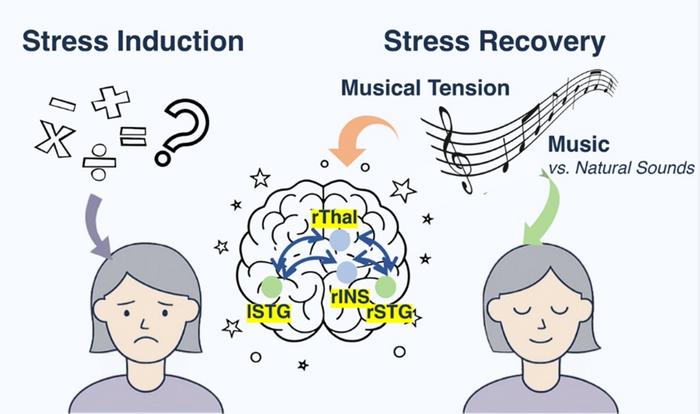
Next, they determined what happens to the STG while listening to music during stress recovery. They also tested the bilateral insula and right thalamus, as they are associated with stress. The fMRI and a method called Dynamic Causal Modeling (DCM) will be able to show if there is any connection between the regions of interest.
They found that during stress recovery, listening to music reorganized the neural network and allowed for better connectivity between different regions of the brain. There was connectivity from the bilateral STG to the insula, and from the insula to the thalamus. The participants who listened to natural sounds did not have this same reorganization. These connections can therefore explain the improvement in positive mood, as the connection between the insula and thalamus was associated with an improvement in positive mood.
Songs with more musical tension have more affect
Lastly, the study tested the effect of musical tension—the different sound dynamics and emotions found across songs—to determine whether it plays a role in stress-relief improvement. The researchers used Dynamic Functional Connectivity (DFC) to track how the neural connections changed in relation to music tension. They found that increased musical tension also improved neural connection interactions from the auditory cortex to the insula; as the stress calms down, so does the interaction.
RELATED: Cats Are Calmed by Cat-Specific Music
Why this is important
Understanding music as a solution for stress can help patients, and it also helps everyone else as they navigate through life’s many challenges.
This study was published in the peer-reviewed journal Proceedings of the National Academy of Sciences of the United States of America (PNAS).
Reference
You, S., Zhang, L., Wu, G., & Du, Y. (2026). The structural dynamics of music drive acute stress recovery through functional reorganization of stress-regulation networks. PNAS, 123(37), e2611584123. https://doi.org/10.1073/pnas.2611584123
About the Author
Rebecca John graduated with a B.S. in biology and was a postbac understanding the binding of specificity of LEDGF/p75 to chromatin. Now she is passionate about pursuing a career in science and health writing to continue writing stories of science. Connect with Rebecca on LinkedIn.