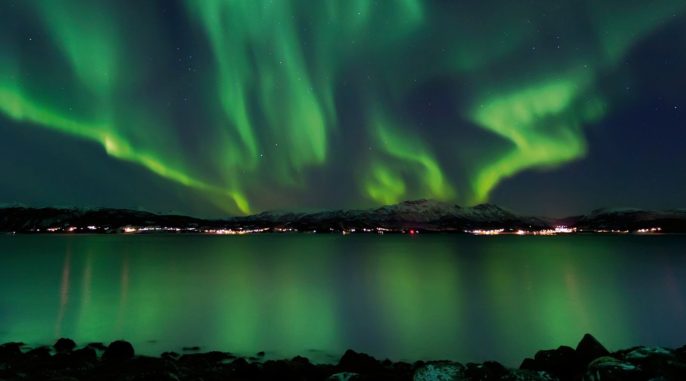








Aurora chasers find a flow state when they participate in science. Learn more about the psychology of flow state and where to find it.
When chasing aurora, have you ever felt your mindset shift? You might think of it as getting into the zone, or into the groove of the chase. “There’s this focus that, once it becomes intense, leads to a sense of ecstasy, a sense of clarity: you know exactly what you want to do from one moment to the other….You know that what you need to do is possible to do, even though difficult, and sense of time disappears, you forget yourself, you feel part of something larger. And once the conditions are present, what you are doing becomes worth doing for its own sake” (Csikszentmihalyi, 2004).

A few years ago, Dr. Liz and project manager Laura began to wonder if aurora chasers—and participatory scientists more broadly—experienced this feeling. It’s something that the late co-founder of the field of positive psychology Mihalyi Csikszentmihalyi (pronounced “Mee-hi Chick-sent-mee-hi”) described as “flow,” because so many people he interviewed described the sensation as creative pursuits like music “flowing out of them” (Csikszentmihalyi, 2004). Flow is a concept that is studied not just in psychology, but in education, and was part of Laura’s museum education coursework. In this post, which is based on a poster we presented at the 2023 Association for Advancing Participatory Sciences conference, we’ll go into the ideas behind flow and how it applies to the science we do together.
What is flow?
Flow state is “being completely involved in an activity for its own sake. The ego falls away. Time flies. Every action, movement, and thought follows inevitably from the previous one, like playing jazz. Your whole being is involved, and you’re using your skills to the utmost” (Geirland, 1996). Perhaps even more relatable to aurora chasers experiencing long drives, frigid temperatures, late nights, and no certainty of actually seeing the Lights, flow is “so enjoyable that people will continue to do [the activity] even at great cost, for the sheer sake of doing it.” (Csikszentmihalyi, 1990). For example, Aurorasaurus Ambassador Justin Anderson once told us about chasing Comet NEOWISE for twelve nights straight in 2020—with three hours of sleep each night. “I don’t know how I could do it now,” he said, “but I’d do it again in a heartbeat.”
Part of the reason this is important is the connection between flow, happiness, and feeling fulfilled in life. According to Csikszentmihalyi, “In the long run, the more flow we experience in our daily lives, the more likely we are to feel happy overall. We’ve also found that the link between flow and happiness depends on whether the flow-producing activity is complex, whether it leads to new challenges and then to personal as well as cultural growth. It provides motivation to pursue high-flow activities.” (Kawamura et al., 2014).
But how do we get to flow? In order to enter a flow state, an activity needs to balance high skill with high challenge level, graphing to the the yellow region shown below.

This shows up in studies in the field of participatory science: for example, in “Motivations, learning and creativity in online citizen science,” Jennett et al. (2016) found that “barriers for engagement included finding the task difficult and/or boring.” Boredom is low in challenge level and moderate in skill level, so it would not accomplish flow. As project leaders, one of our goals is to work toward supporting your skill growth to balance the challenge level of chasing aurora.
Flow and participatory science
Participatory science is a shared endeavor: we have the goal of doing amazing science together. Your experience as a volunteer shapes the data that is gathered, and it’s important that we reciprocate by providing you with an impactful experience.
While Csikszentmihalyi wrote his influential book Flow: The Psychology of Optimal Experience prior to the rise of participatory science as a recognized field, he included a section on flow in science and amateur science. “The mental framework that makes science enjoyable,” he says, “is accessible to everyone. It involves curiosity, careful observation, a disciplined way of recording events, and finding ways to tease out the underlying regularities in what one learns. It also requires the humility to be willing to learn from the results of past investigators, coupled with enough skepticism and openness of mind to reject beliefs that are not supported by facts….If flow, rather than success and recognition, is the measure by which to judge its value, science can contribute immensely to the quality of life.”
Studies of citizen science motivation often overlap with the concept of flow or cite Csikszentmihalyi (Jennett, 2016; Tiago, 2017), but in our poster we suggested that we might be able to serve our volunteers even better by studying it more and including flow in the way we evaluate our projects.
RELATED: Find a flow state of your own with one of these citizen science projects.
Flow and aurora chasing
Csikszentmihalyi identified seven key components of flow. When we listen to aurora chasers or read about their experiences, we find that they match the components very well:
| Component of Flow | Aurora Chaser’s Experience |
| Completely involved in what they are doing—focused, concentrated | “Especially during the bigger [solar] storms that last four or five days, you end up having your life consumed by it. You don’t really get sleep, and you end up having this weird routine that’s based around the aurora.” —Alaskan student and aurora chaser Andy Witteman (Aurorasaurus, 2021). |
| A sense of ecstasy—of being outside everyday reality | “I think it puts you in a completely different world…it is a very mesmerizing experience.” —Alberta Aurora Chaser Chandresh “C.K.” Kedhambadi, Chasing Steve (Fraser & Mallen, 2019). |
| Great inner clarity—knowing what needs to be done, and how well they are doing | “The chase really starts when we start watching the Sun, and we start watching the data. And we start looking to see: what’s happening on the Sun? Is there a solar flare? Is there a coronal hole? Is that affecting the solar wind between the Earth and the Sun? And then we start watching the sky to see: where are we going to be able to find the clearest sky? You can end up driving around quite a bit.”—Alberta Aurora Chaser Chris Ratzlaff, Chasing Steve (Fraser & Mallen, 2019). |
| Knowing that the activity is doable—that their skills are adequate to the task | “Part of the appeal is definitely the thrill of the chase because there is never a guarantee that you will see the Northern Lights. There is a real challenge in understanding when they might be visible. You always require a degree of luck as well but when things go your way the sense of achievement is huge.” —Scottish aurora chaser Gordon Mackie (Winterman, 2014). |
| A sense of serenity—no worries about oneself, and a feeling of growing beyond the boundaries of the ego | “When I’m outside and I’m looking at the stars, I’m looking at the Northern Lights, I’m looking at everything that’s happening above me, it is humbling. We’re made of the same stuff. I’m a part of everything that’s happening in the sky.” —Alberta Aurora Chaser Song Despins, Chasing Steve (Fraser & Mallen, 2019). |
| Timelessness—thoroughly focused on the present, hours seem to pass by in minutes | “I’ll be out all night if I don’t keep track of the time. Monday night I was out from 7pm to 2am and it felt like an hour.” —Manitoba astrophotographer Justin Anderson (Aurorasaurus, 2021). |
| Intrinsic motivation—whatever produces flow becomes its own reward | “Hunting the Northern Lights is pure escapism for me, a way to tune out from what’s gone on in the day. They are addictive, there is a compulsion to see more and more. We get compared to tornado chasers in the US and it is that same sort of obsession. It’s exciting, you get a real high from it.”—Scottish aurora chaser Barry Stewart (Winterman, 2014). |
These aspects, especially the serenity of dark skies and reward of watching the everchanging aurora, feel very familiar. In short, we think that flow might be a very positive part of the aurora chase, as well as the pursuit of participatory science. A paper by Jennett et al. (2016) points out that “volunteers are motivated to contribute more than once if they feel like they have an aptitude for the task, they enjoy participating in the task, and/or they enjoy participating in the activities surrounding the project.” These aspects tie in with Csikszentmihalyi’s components of inner clarity and knowing the activity is doable. Knowledge of a person’s own aptitude also relates to having good feedback, which Csikszentmihalyi links to flow (Kawamura, 2014). Participatory science can increase the flow reward potential for aurora chasers by providing affirmation of the aurora chaser’s skills, both in real time and after the fact. Aurora chaser Andy Witteman pointed out to us in conversation that while taking a beautiful photo of the aurora is exciting, it is also validating to find out months or years afterward that it contains interesting scientific phenomena. It makes a difference to hear this from scientists, who study these phenomena for a living. In that way, we can weave multiple forms of expertise and learn about the aurora together.

In conclusion
Flow is an experience that we can find in many aspects of life. For example, Dr. Liz gets into flow foraging for fungi. Project manager Laura experiences flow getting people excited about science in outreach presentations—or crafting for her nerdy fandoms. Participatory science at its best weaves a positive feedback loop between doing science, increasing knowledge about phenomena, and having good experiences. Based on our observations, as well as those of aurora chasers and Csikszentmihalyi himself, we suspect that aurora chasers enter flow states that might inspire involvement in participatory science activities. Put another way, Ambassador Tanya Melnik recently asked whether participation in a citizen science project can further enhance enjoyment of the aurora experience. This was inspired by a paper on enjoyment and photography. The authors note that “photo-taking directs people’s attention to the specific aspects and moments of the experience they want to capture, rather than heightening engagement across all aspects of the experience.” The implication for aurora chasing is that photography engages people more deeply with the aurora itself, similar to slow looking practice in museums. In our poster, we suggested that other participatory science projects could also benefit from looking into the extent to which flow influences participation, in order to enhance or avoid interfering with participants achieving flow. It’s a place where wellbeing and doing science align: “The best moments usually occur when a person’s body or mind is stretched to its limits in a voluntary effort to accomplish something difficult and worthwhile.” (Csikszentmihalyi, 1990). What are some ways you find flow in your aurora chasing?
Resources
Aurorasaurus (2021). Aurorasaurus Q&A on Informal Education and Kp Fox [Video]. YouTube. https://www.youtube.com/watch?v=s8YbZ4sG_Xs
Brandt, L. & MacDonald, E.A. (2020). A Science Products Inventory: Case Study Applications for Evaluating NASA Citizen Science Projects. AGU Fall Meeting 2020. https://agu.confex.com/agu/fm20/meetingapp.cgi/Paper/693915
Csikszentmihalyi, M. (2004). Flow, the secret to happiness [Video]. TED Conferences. https://www.ted.com/talks/mihaly_csikszentmihalyi_flow_the_secret_to_happiness
Geirland, John (1996). “Go With The Flow”. Wired magazine, September, Issue 4.09. https://www.wired.com/1996/09/czik/
Fleer, M. Scientific Playworlds: a Model of Teaching Science in Play-Based Settings. Res Sci Educ 49, 1257–1278 (2019). https://doi.org/10.1007/s11165-017-9653-z
Fraser, J. & Mallen, L. (Directors). (2019). Chasing Steve [Film]. TELUS World of Science. https://vimeo.com/ondemand/chasingsteve/
Jackson, et al. (2020). Shifting Forms of Engagement: Volunteer Learning in Online Citizen Science. Proc. ACM Hum.-Comput. Interact. 4, CSCW1, Article 36 (May 2020), 19 pages. https://doi.org/10.1145/3392841
Jennett, J., et al. (2016). ‘Motivations, learning and creativity in online citizen science’. JCOM 15 (03), A05. https://jcom.sissa.it/sites/default/files/documents/JCOM_1503_2016_A05.pdf
Kanhadilok, P. & Watts, M. (2014) Adult play-learning: Observing informal family education at a science museum, Studies in the Education of Adults, 46:1, 23-41, DOI: 10.1080/02660830.2014.11661655
Kawamura, K.M. (2014), “Kristine Marin Kawamura, PhD interviews Mihaly Csikszentmihalyi, PhD”, Cross Cultural Management: An International Journal, Vol. 21 No. 4. https://doi.org/10.1108/CCM-08-2014-0094
Lonczak, H.L. (2020), “How to Measure Flow with Scales and Questionnaires”, [Blog]. Positivepsychology.com. https://positivepsychology.com/how-to-measure-flow-scales-questionnaires/
Moneta G.B. (2012) On the Measurement and Conceptualization of Flow. In: Engeser S. (eds) Advances in Flow Research. Springer, New York, NY. https://doi.org/10.1007/978-1-4614-2359-1_2
Tiago et al., (2017) The influence of motivational factors on the frequency of participation in citizen science activities, Nature Conservation https://natureconservation.pensoft.net/articles.php?id=13429
Winterman, D. (2014). Aurora hunters: The people who chase the Northern Lights. BBC News. https://www.bbc.com/news/magazine-26646648.
This article was originally published in the Aurorasaurus blog on August 22, 2025.
Featured image: Aurora, photo by Alberta Aurora Chaser and Aurorasaurus Ambassador Hugo Sanchez.