
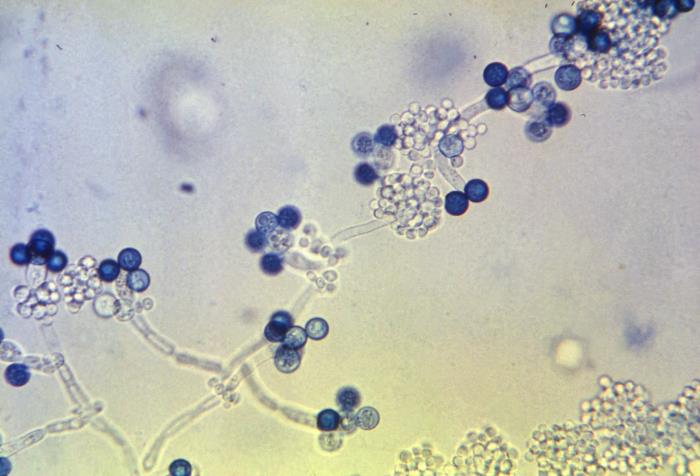







Fungal infections are widespread and tricky to kill off, but could we disarm them instead? A look at Candida albicans and a bacterial antibiotic.
By Akshara Ramaswamy
What do mushrooms, yeast, and mold all have in common? That’s right, they’re all types of fungi! Fungi are multi-celled organisms that you may find growing on a stale piece of bread or as a delicious topping on your pizza.
When it comes to global health crises, fungi probably isn’t the first thing you think of. But according to the Centers for Disease Control and Prevention, fungal infections affect over one billion people. Research estimates from 2024 link fungal infections to an estimated 3.8 million deaths globally each year. The main perpetrator? The fungus Candida albicans. Normally harmless, C. albicans can be found in the mouth, skin, and digestive tracts of healthy adults. If balance is disrupted, it can develop into a severe infection, threatening the lives of those with already compromised immune systems.
However, a new discovery by researchers teaming up from Monash University and the University of Warwick reveals a bacterial antibiotic may hold the key to fighting fungal infections.
What makes fungal infections so dangerous?
Fungal infections are notorious for being hard to cure. Firstly, fungal cells and human cells are very similar as they’re both eukaryotic (having a nucleus), making it hard to create treatments that target fungal cells without also targeting our cells. Put simply, antifungal medications successfully kill fungal cells, but they kill human cells too! Because of this, fungal infections are both dangerous to have and dangerous to treat.
Additionally, fungal infections only respond to a few types of antifungal medication because of a phenomenon known as antimicrobial resistance. Antimicrobial resistance occurs when microbes, like fungus, develop the ability to resist antibiotic treatment. This happens because of evolution. It’s like “survival of the fittest.” If a treatment doesn’t kill all of a targeted microbe, each of the surviving microbes has the ability to resist treatment that it then passes on to its offspring. If someone with a microbial disease doesn’t complete a full dosage of antibiotic medication, they may be inadvertently helping stronger microbes evolve.
New strains of resistant fungi have already become widespread, making fungal infections even harder to treat safely. The already narrow range of antifungal medication is becoming even slimmer as they lose their effectiveness. But when dangerous diseases evolve, our approaches to curing them must evolve as well.
Gladiolin: An innovative breakthrough
The researchers studied fungal infections to increase scientific understanding of antimicrobial resistance. They discovered the fungus-fighter potential in the bacterial antibiotic gladiolin.
What makes this antibiotic so special? Gladiolin doesn’t have to kill C. albicans—it just has to disarm it! C. albicans have long, tube-shaped cell structures called hyphae that allow them to pierce cells and spread their destructive proteins. However, the researchers found that gladiolin turns off these harmful hyphae and forces the fungus into a less harmful form.
Gladolin triggers changes in the metabolism of C. albicans, forcing it to quickly deplete the glucose in its environment. Because this glucose is necessary for growing its harmful hyphae, gladiolin effectively switches the fungus back to its noninvasive state.
This method of disabling rather than killing helps to reduce incidence of antimicrobial resistance. Strains of fungi can only develop resistance because antifungal medications leave some surviving fungi that then reproduce and pass on their survival traits to offspring. Treating microbial disease without killing the microbes slows this form of evolution, allowing current treatments to stay effective for longer.
Potential synergy
Not only is gladiolin effective at fighting C. albicans on its own, it also enhances the capabilities of other antifungal medications. Such compatibility between drugs is called synergy. Gladiolin’s synergistic effects help to boost the power of our current treatments, including the leading antifungal treatment amphotericin B. Gladiolin also has the potential to tackle the dangerous biofilms that grow on medical devices. This could allow for less toxic doses of other antifungals to be administered to patients.
RELATED: A New Way to Treat Antibiotic Resistant Bacteria
Gladiolin’s impact
The impacts of this novel discovery go deeper than just biomedical research. The Monash Warwick Alliance Programme in Antimicrobial Resistance (AMR) brought together researchers from different countries and disciplines to tackle one of medicine’s most pressing problems. Their success exemplifies the power of international collaboration and the importance of global research programs. As the world continues to face new, complex problems, it will take teams of experts from across the world to come up with ingenious ways to solve them.
This study was published in the peer-reviewed journal Current Biology.
References
Bharathwaj, M., Hofferek, V., Swaminathan, A., Turner, R., Olivier, F. A. B., Prabhakaran, M., Zhang, Y., McConville, M. J., Challis, G. L., Beilharz, T. H., & Traven, A. (2026). A bacterial metabolite rewires fungal metabolism, triggering the hyphae-to-yeast transition. Current Biology, 36(17), 4429–4443.e4. https://doi.org/10.1016/j.cub.2026.07.057
Centers for Disease Control and Prevention. (2026, September 24). About fungal diseases. https://www.cdc.gov/fungal/about/index.html
Cleveland Clinic. (2025, May 13). Candida albicans. https://my.clevelandclinic.org/health/diseases/22961-candida-albicans
Dall, C. (2024, January 16). Global mortality from fungal diseases has nearly doubled. Center for Infectious Disease Research and Policy (CIDRAP). https://www.cidrap.umn.edu/antimicrobial-stewardship/global-mortality-fungal-diseases-has-nearly-doubled
Featured image is photomicrograph of Candida albicans, showing tube-like hyphae. Source: CDC/Dr. Robertstad, in public domain.
The information contained in this article is for informational purposes only and is not intended as health or medical advice. Always consult a physician or other qualified health provider regarding any questions you may have about a medical condition or health objectives.
About the Author
Akshara Ramaswamy is a high school student and aspiring doctor from Florida who is passionate about biotech and public health. She believes science should be fun and accessible for all audiences. You can catch her devouring a sci-fi novel or jamming out to classical music.